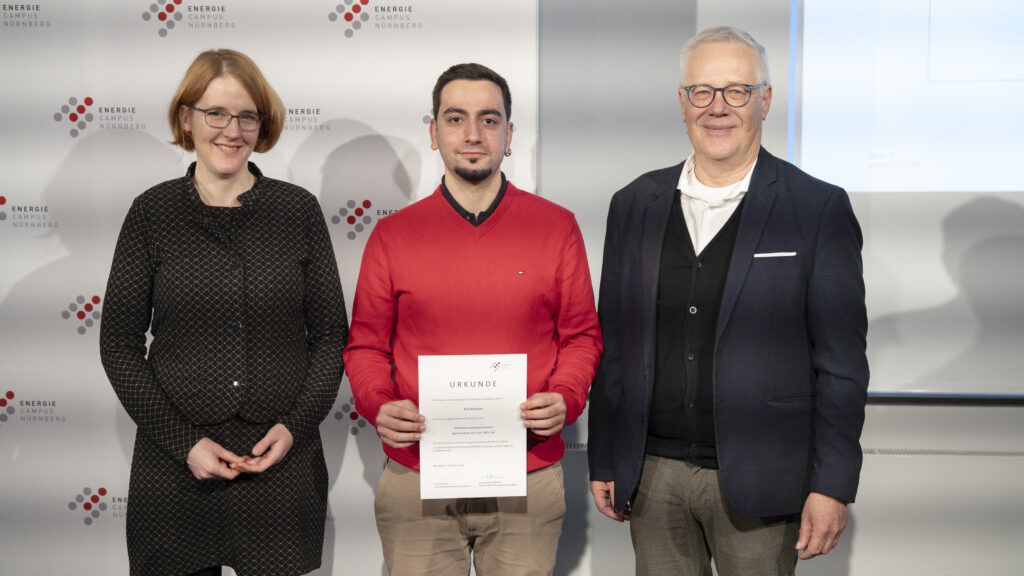
Scaling high-efficiency OPV cells from < 0.1 cm² to > 1 cm²: Congratulations to Aral on winning the EnCN Energiepreis 2025 for his MSc thesis!
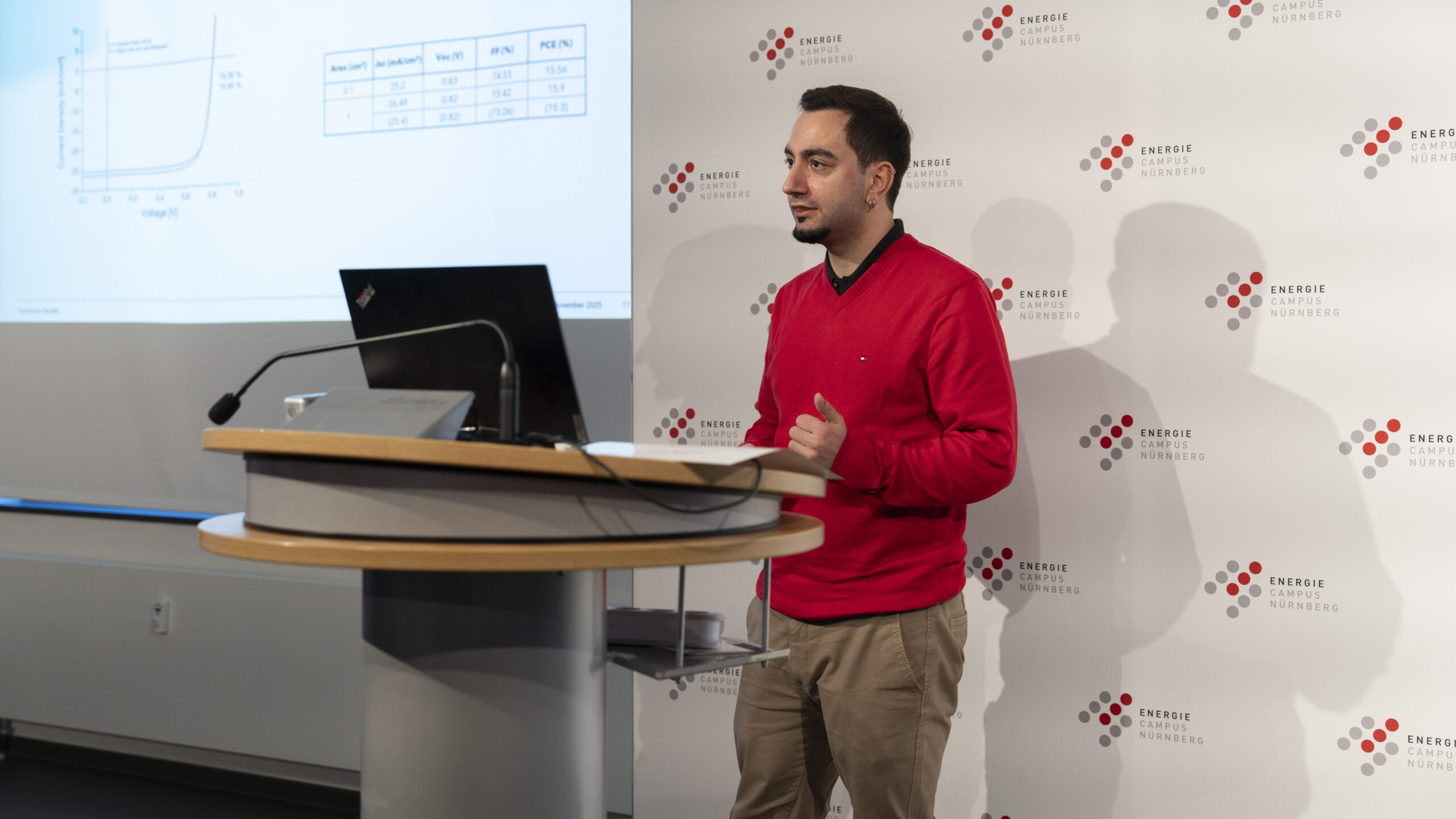
Organic photovoltaics (OPVs) are emerging as a key technology for the energy transition, thanks to their flexibility, low weight and compatibility with roll-to-roll manufacturing. Yet scaling state-of-the-art OPV cells from sub-0.1 cm² test devices to technologically relevant areas without sacrificing efficiency remains a major bottleneck. This challenge is addressed in Aral Karahan’s Master’s thesis, which was conducted at the Solar Factory of the Future (SFF) under the supervision of Dr Andreas Distler. The thesis has been awarded the EnCN Energiepreis 2025. Using finite-element simulations, the work systematically optimised the layout of 1 cm² OPV cells by varying aspect ratios, electrode sheet resistances and charge-collection geometries. The best designs were then realised experimentally by doctor-blade coating on large-area substrates, laser structuring with a femtosecond laser, and subsequent device characterisation. The champion 1 cm² device achieved a power conversion efficiency of 15.9 %, with a fill factor of 73.3 % and a short-circuit current density of 25.4 mA cm⁻² – performance that exceeds the current certified world record for OPV cells with active areas larger than 1 cm². Beyond this milestone, the thesis provides a scalable design framework that directly informs the upscaling of organic solar technology from laboratory cells to industrially relevant modules.
We warmly congratulate Aral on receiving the EnCN Energiepreis 2025 and wish him all the best for his future career. He has now started his PhD in Marseille, France, in the Videlot-Ackermann group, where he continues his work on organic photovoltaics.